UK Inheritance Tax: What You Need to Know
Published on 24th Feb 2026

UK Inheritance tax legislation is changing, and it will impact farming families and business owners. There are also implications for those without agricultural land and business interests, as the freeze on inheritance tax thresholds will inevitably include more estates as property value rises. HMRC data shows that the proportion of estates paying inheritance tax has been rising steadily. The OBR forecasts that fixing thresholds through to 2030-31 will increase the number of taxable estates by approximately 2,100 compared with what indexation would have produced. Families who never considered themselves "wealthy" may find themselves facing an IHT liability simply because house price growth has carried their estate over the frozen threshold. You can find out the key changes taking place in April 2026, what they mean in practice and the action you can take.
Main takeaways:
- From 6 April 2026, Agricultural Property Relief (APR) and Business Property Relief (BPR) will be capped at £2.5 million per person at the 100% rate
- Married couples and civil partners can combine allowances to shelter up to £5 million in qualifying farm or business assets.
- Assets above the new threshold will face an effective Inheritance Tax rate of 20%, not the full 40%.
- The Nil-Rate Band (£325,000) and Residence Nil-Rate Band (£175,000) remain frozen until at least 2030-31.
- Pension pots will be brought into the inheritance tax net from 6 April 2027.
- Alternative Investment Market (AIM) share inheritance tax relief is reduced from 100% to 50% from 6 April 2026. |
The Nil-Rate Band (NRB)
Every individual can pass up to £325,000 free of inheritance tax. This is known as the Nil-Rate Band. Any estate above this threshold is taxed at the standard rate of 40%. Plus, any unused NRB can be transferred to a surviving spouse or civil partner, giving couples a combined potential allowance of £650,000. This threshold has not changed since 2009, and the threshold has been extended until the end of the 2030-31 tax year. If property values continue to increase over this period, then more estates will be pulled into the tax bracket during this period.
The Residence Nil-Rate Band (RNRB)
Introduced in 2017-18, the RNRB provides an additional allowance of up to £175,000 per person where a main residence is passed to direct descendants, including children, grandchildren, stepchildren, and adopted children. Like the NRB, unused RNRB can be transferred between spouses and civil partners. For a married couple leaving their home to their children, the combined NRB and RNRB can therefore reach £1,000,000. If you are living with a partner and are not in a civil partnership or married, this will impact both your NRB and your RNRB. It is important to note that RNRB is tapered for estates valued above £2 million, reducing by £1 for every £2 of value above that threshold. It disappears entirely where the net estate exceeds £2.35 million. This taper can have unexpected implications for some larger estates.
Agricultural Property Relief and Business Property Relief Reforms
There will be significant changes to Agricultural Property Relief (APR) and Business Property Relief (BPR). Known colloquially as the Family Farm Tax, the tax relief to pass on farms and business in full, without inheritance tax, is coming to an end. The threshold for 100% APR/BPR relief will now be set at £2.5 million per person, up from the originally proposed £1 million. This change is being legislated through an amendment to the Finance Bill in January 2026 and takes effect from 6 April 2026.
Transferring unused APR and BPR between spouses
A further change, announced at the November 2025 Budget, provides that any unused portion of the £2.5 million allowance will be transferable between spouses and civil partners. This mirrors the existing transfer rules for the NRB and RNRB. Potentially, a married couple or civil partner could pass on up to £5 million in qualifying agricultural or business assets at the 100% relief rate. This benefit extends to widowed spouses and civil partners whose partner died before 6 April 2026. Those individuals will be treated as having a full £2.5 million allowance to transfer to their surviving partner, even if the first death predates the new regime.
Summary of the APR and BPR Changes
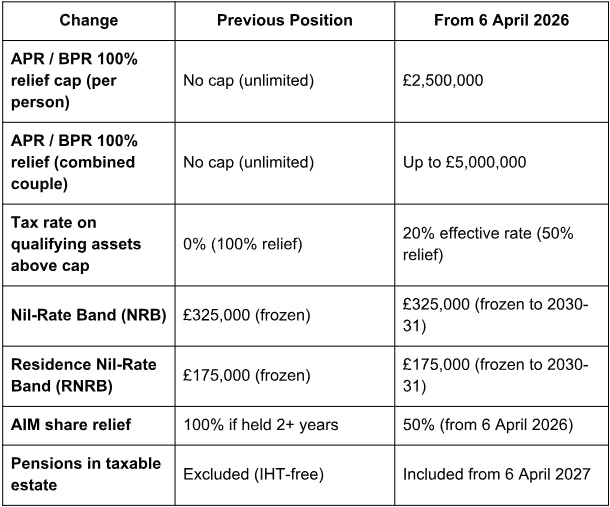
Inheritance Tax Implications for Family Farms
According to HMRC figures, the revised threshold is expected to halve the number of estates claiming APR that are affected by the reforms. This is expected to reduce the count from approximately 375 to around 185 estates in 2026-27. Around 85% of estates claiming APR in 2026-27 are forecast to pay no additional inheritance tax as a result of the reforms.
For farming families with higher-value estates, planning remains essential. Where the combined value of qualifying agricultural assets exceeds £5 million (or £2.5 million for a single owner), the excess will be subject to the effective 20% rate. Early succession planning, review of ownership structures, and consideration of lifetime gifts may all be appropriate. We recommend that you take advice as soon as possible to understand your options.
Implications for Family Businesses and BPR
The same cap applies to business assets qualifying for BPR. The number of estates only claiming BPR (excluding those holding AIM shares) that are affected by the reforms is expected to fall by around a third because of the threshold increase. Business owners should review whether their assets genuinely qualify for BPR. BPR tax relief carries detailed conditions around trading activity, ownership period, and asset use. Again, taking advice before the changes can help you better understand the options available.
AIM Share Investors
Investors who have held Alternative Investment Market (AIM) shares for inheritance tax mitigation purposes should be aware that the relief on qualifying AIM shares will be reduced from 100% to 50% from 6 April 2026. Currently, shares designated as "not listed" on recognised stock exchange markets that have been held for at least two years can pass free of inheritance tax. After 6 April 2026, this will only provide 50% relief, creating an effective inheritance tax rate of 20%. Pensions and Inheritance Tax from April 2027 While the April 2026 reforms are the most immediate concern, a further significant change is already legislated for 6 April 2027. From that date, most unused defined contribution pension funds and death benefits will be included in the value of a deceased person's estate for inheritance tax purposes. This reverses a long-standing rule that has made pensions one of the most tax-efficient vehicles for intergenerational wealth transfer. HMRC estimates that approximately 10,500 more estates will pay inheritance tax for the first time as a result of this change, and that some 38,500 estates will face higher tax bills. The reforms do not affect dependants' pensions paid from defined benefit (final salary) schemes, survivors' pensions under annuities, or pensions left to a spouse or civil partner, which remain covered by the spousal exemption. In practical terms, the change means that executors will be responsible for including pension values in the inheritance tax return. There are concerns in the profession about the timing mismatch between the obligation to pay inheritance tax within six months of the end of the month of death, and pension providers' right to take up to two years to identify and pay beneficiaries. The government has introduced a mechanism permitting personal representatives to instruct pension administrators to withhold funds for up to 15 months to cover any inheritance tax liability.
Practical Steps for Inheritance Tax Changes
Given the scale and complexity of these reforms, it is essential to get timely,
professional advice.
- Review your Will. Wills drafted before these reforms may no longer reflect the most tax-efficient approach to your estate. In particular, the interaction of the NRB, RNRB, and the new APR/BPR allowance deserves careful attention.
- Check APR and BPR eligibility. Not all farm or business assets automatically qualify for relief. Conditions relate to the nature of the business or agricultural activity, how long assets have been held, and how they are used. Do not assume relief applies.
- Consider asset ownership structures. Where combined qualifying assets exceed the £2.5 million threshold per person, it may be beneficial to restructure ownership between spouses or civil partners. This should be undertaken with legal and tax advice.
- Review pension nominations. It may be worth reviewing whether the nomination of beneficiaries on your pension still makes sense. In some cases, nominating a spouse or civil partner who benefits from the spousal exemption ahead of the 2027 change may reduce overall inheritance tax.
- Consider lifetime gifting. Gifts made more than seven years before death are generally outside the estate for inheritance tax purposes. The annual gift exemption (£3,000 per person, with carry-forward of one unused year) and other exemptions remain available and should not be overlooked.
- Act before 6 April 2026. While the revised threshold is more generous than originally proposed, those with estates above £2.5 million in qualifying assets, and who have not yet explored planning options, should seek advice. The window before the new rules apply is narrow.
Nicholas & Co Can Help
Our expert team is on hand to guide you through these changes and review whether your current estate planning needs updating to reflect the new legislation. Get in touch to find out how we can help you plan for the upcoming changes to inheritance tax.
This blog is provided for general information purposes only and does not constitute legal advice. Tax law is complex and subject to change; the information above reflects the law as understood at the time of writing. You should not act on anything contained in this blog without obtaining specific legal and/or tax advice relevant to your own circumstances. Nicholas & Co accepts no liability for any action taken or not taken on the basis of the information contained in this document.
